Fiction
Exact Change
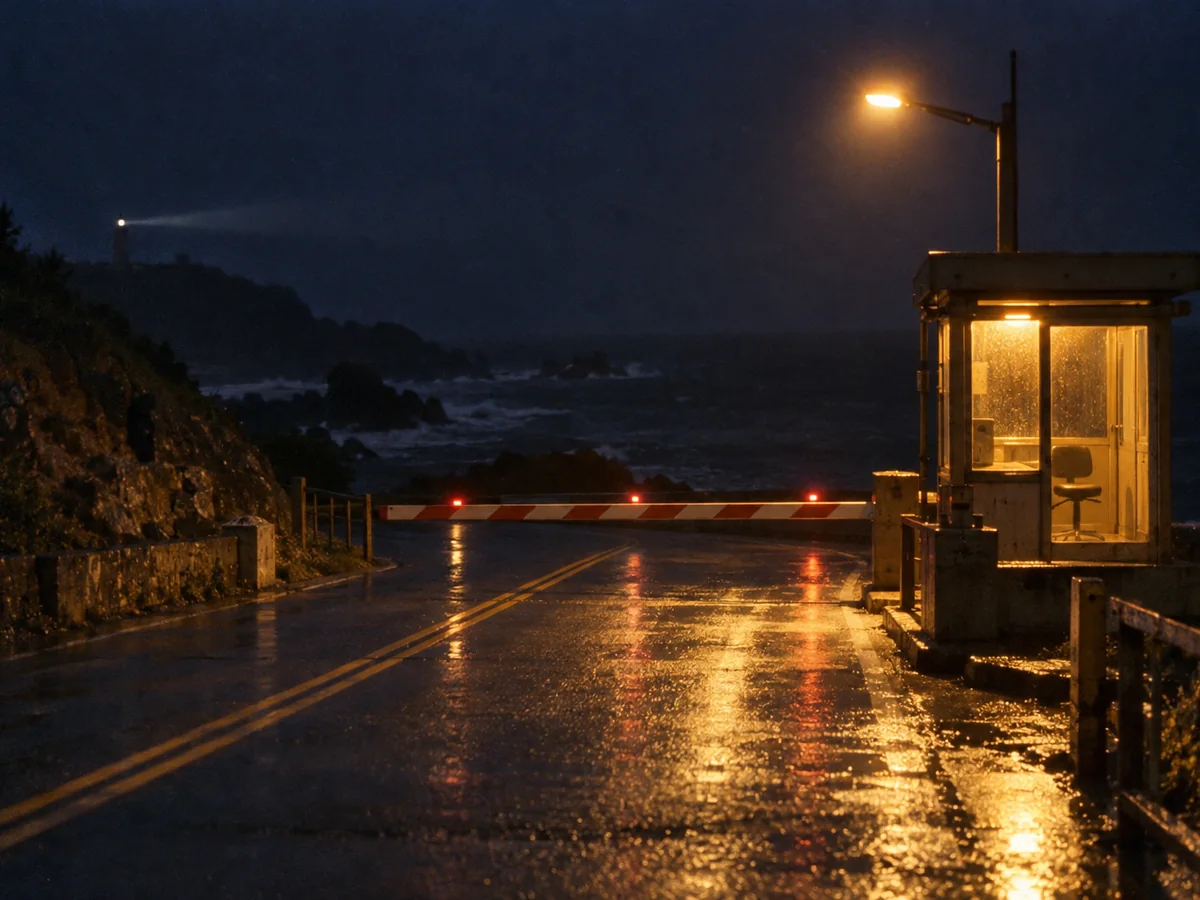
Between three and four in the morning, people will tell a toll booth anything.
Edie Pruett had worked the night lane at Mile 212 for eleven years, and she had the ledgers to prove it. Proper ones: green cloth, red spines, the kind the Coast Road Authority stopped ordering in 1994 and still, apparently, had a room full of. The printed columns were for float and takings. Edie ruled her own. TIME, PLATE, FARE, REMARKS. It only counted if they said it while money was changing hands, and only in the three o’clock hour. Before three, people were still on their way somewhere. After four, they were thinking about breakfast. At three they were nowhere at all, and they talked.
“Is it always this quiet?” (03:12, a rental, two-fifty.) “Keep the change, buy yourself a window.” (03:31, a man who left no change.) “I’ve just been fired, but nicely.” “She said yes. Well, she said ‘probably’, but in that voice.” “Which way’s the sea?” That last one came from a man in a delivery van, with the sea forty feet to his left, making the noise it makes.
Edie wrote them all down in pencil, because pen was for money.
The regulars had their own pages. The woman in the green Volvo paid in coins she had counted into a film canister at home, and never said anything except, once, in a February fog: “I think I’m the only person awake in the world.” Edie underlined that. The lad from the fish plant said “Evening, Captain” every night for three years before admitting he thought she was someone else. And there was Teo from the Gullhaven bakery, who drove the bread van north at twenty to four and announced the loaf count the way other men announce the football.
“Four hundred and twelve,” he would say, handing over a twenty. “And one for you.” Then a warm roll through the window, and a long wait while Edie made change, because in six years Teo had never once had the exact money, and she had stopped asking.
The letter came in October, in an envelope with a window, which Edie thought was a bit much. The Authority was moving to Open Road Tolling. From the first of December a gantry of cameras would read every plate at Mile 212 and post the bill. The booth would be “retired”. Edie was offered a position cleaning the gantry lenses. Days.
“It’s a promotion, technically,” said Ray, her supervisor, who worked from a portable office behind the booth and microwaved soup at half one every night, so that the whole plaza briefly smelled of minestrone. “You’ll see daylight.”
“I’ve seen it,” said Edie. “It’s overrated.”
“It says here the cameras will read the plates.” Ray turned the letter over, in case there was more on the back. There wasn’t. “Quicker for everyone.”
“They’ll read the plates,” Edie agreed.
That night she took the nine ledgers out from under the till and read them, which she had never done. She had always assumed they were for somebody, and that it would become clear who when the time came. It did not become clear. They were four thousand nights of the coast road talking to itself. Proposals and diagnoses. Directions to the sea. A man who stopped every week to ask whether it was “the good fog or the bad fog”, and seemed satisfied either way. A girl, 03:17 on a Tuesday, paying for her dad: “He’s asleep, but he’d want you to know he says hello.” Edie had written that one down very carefully.
She read until the bread van came, and then she had to find a pencil.
The last night was a Thursday. Nobody knew except Ray, and Ray had brought a cake, which he ate most of himself between midnight and two, apologising.
The three o’clock hour was quiet. A rental. A horsebox. The green Volvo, film canister, nothing to say. Edie wrote down the nothing, as she always did: a dash in the REMARKS column, neat as a stitch. Up on the new gantry the cameras had been switched on for testing, and now and then one of them blinked red at nobody.
At twenty to four the bread van pulled in, and Teo didn’t hand her a twenty. He handed her a school exercise book, the blue kind, soft with use.
“Been keeping one too,” he said.
It was her. Six years of her, a line a night, in capitals. TWO-FIFTY. TWO-FIFTY. MIND THE FOG. TWO-FIFTY. YOUR TAIL LIGHT’S OUT. TWO-FIFTY. HAPPY CHRISTMAS TEO. Now and then a note in brackets: (Seemed tired.) (New cardigan.) (Laughed at the thing about Mira’s knees.) Mira was his wife. Edie had never met her, but knew a great deal about her knees.
Halfway down a page from four winters ago, in the same careful capitals: I’D MISS THIS, YOU KNOW.
“I never said that.”
“You did. You had a cold.”
She turned the pages. The book ran right up to tonight, and stopped at an empty line.
“Go on, then,” said Teo. “Last one. Make it good.”
Edie gave it proper thought. She thought about the proposals and the diagnoses, and the girl whose dad said hello, and the man who wanted to know which way the sea was, and the sea, forty feet away, making its noise. Everyone had told her something. It only seemed fair.
“Two-fifty,” she said.
Teo laughed so hard he leaned on the horn. The whole plaza jumped, and Ray came out of the portable holding a spoon. Then Teo counted two-fifty into her palm, coin by coin, exactly.
“Took me six years,” he said. “Four hundred and nine tonight. And one for you.” The roll was still warm. “Same time tomorrow.”
He pulled away north. His tail light was out again.
Edie opened the ninth ledger at the last line and wrote: 03:41. GUL 4. 2.50. “Same time tomorrow.” Then, because it was her ledger and she could, she added: He’s wrong. Entered anyway.
Above the road the camera blinked, and read the plate, and wrote down nothing at all. The end.
2